



- About UPF-BSM
- Programs
- Faculty and research
- Companies and Organizations
- News & Events


Only 17% of family businesses are highly professionalized
18 Marzo - 2026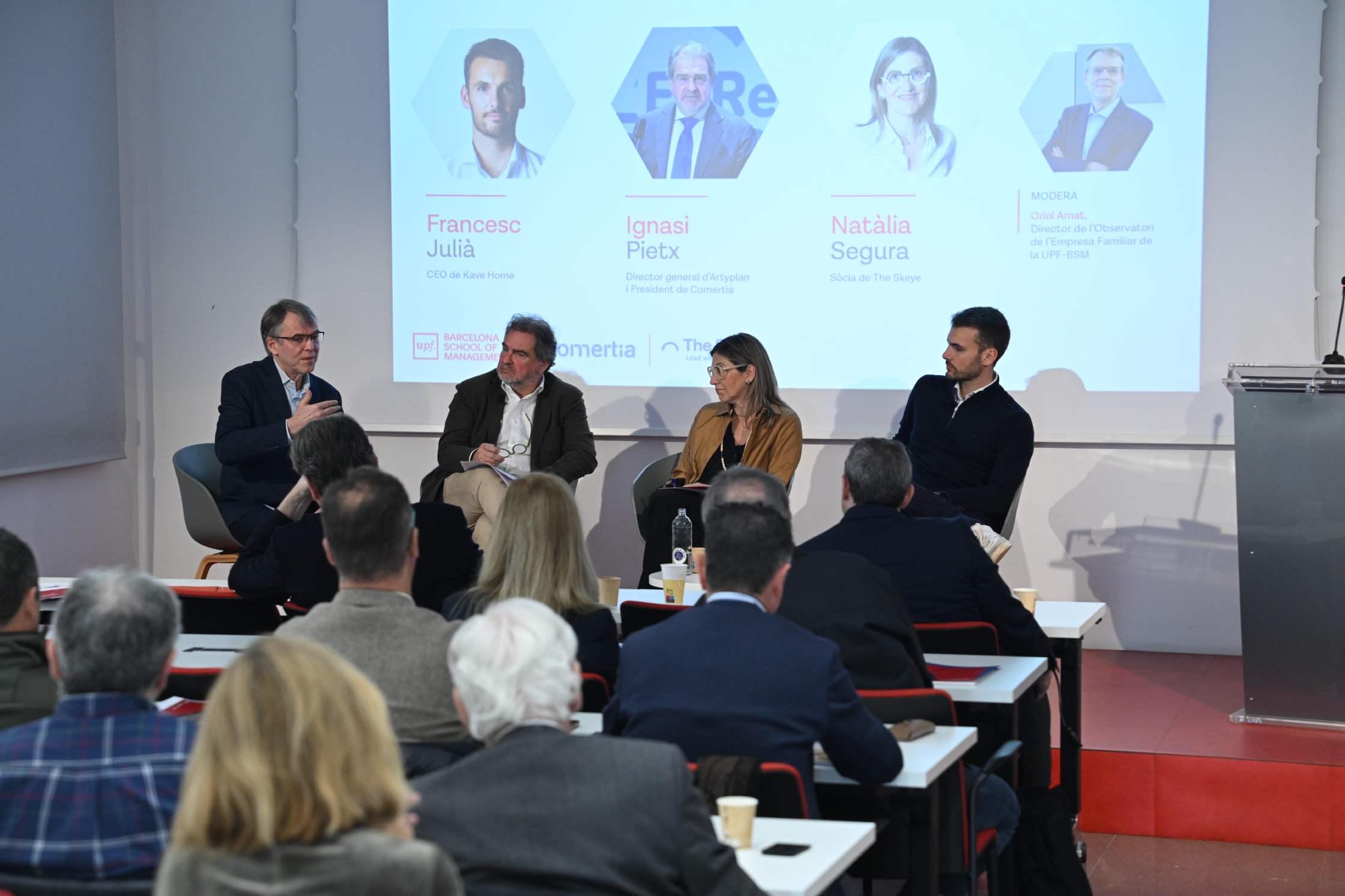
UPF-BSM publishes the study “The Professionalization of Family Businesses”, which analyzes the presence of formal governance, planning, and control practices in more than one hundred family-owned companies.
Only 17% of family businesses in Spain have a high level of professionalization, according to the report “The Professionalization of Family Businesses”, produced by the Observatory of Family Business at the UPF Barcelona School of Management (UPF-BSM) in collaboration with Comertia and The Skeye. The study, presented today at the UPF-BSM headquarters, analyzes the professionalization of family businesses from a structural perspective, focusing exclusively on the presence of formal governance, planning, and control practices.
The aim of the research—led by Oriol Amat, professor at UPF-BSM and director of the Family Business Observatory, and Jordi Tarragona, professor at UPF-BSM and advisor to business families—has been to measure the extent to which family businesses have organizational structures that prepare them to face the challenges of continuity, “a key element to ensure their long-term sustainability,” according to the experts.
The results show that most companies (40%) have an intermediate structured model of professionalization, which includes features such as the separation between the chairmanship and executive management, systematically audited accounts, a formal and active board of directors, and the existence of both a family constitution (protocol) and a family council. This majority category is followed by companies that are in the process of professionalization (33%), those with a highly professionalized model (17%), and those with an informal model with very low levels of professionalization (10%).
“The analysis shows uneven professionalization. Practices related to regulatory compliance and basic control, such as financial auditing or aligning family members’ compensation with market criteria, are relatively widespread. In contrast, practices associated with more advanced governance show clearly lower levels of implementation, despite their high potential impact on business continuity,” explained Oriol Amat during the presentation. Jordi Tarragona added that “the professionalization of family businesses is not an end in itself, but a means to maximize their continuity.”
Corporate governance and management
Regarding the most widely implemented professionalization practices, financial auditing is the most распространенная, present in 62% of companies. In addition, 52% of companies have a Board of Directors or an Advisory Board. Of these, only 39% have a board with a significant presence (25% or more) of independent members, which, according to experts, is a key element for introducing external perspectives and reducing the risk of family bias.
On the other hand, the separation between the chair of the board and the CEO occurs in 46% of companies that have a board. The report also highlights that the implementation of specific advanced control mechanisms, such as an audit committee, remains “very limited,” as only 15% of companies with a board have such a body.
Family governance and ownership
Another key conclusion is that only 36% of companies have a formalized Family Constitution (and 59% have updated it in the past five years). Meanwhile, only 35% of companies have an established Family Council. “Without professionalizing the family, it is not possible to professionalize the business,” noted Tarragona. “This absence of a specific forum for family deliberation makes it difficult to separate the spheres of family, ownership, and business, and increases the risk that family conflicts spill over into business management,” added Amat.
The report also points out that the implementation of practices aimed at continuous governance improvement is even more limited. Only 25% of companies conduct periodic evaluations of the performance of their governance bodies, both corporate and family.
Study methodology: Professionalization Index
The research analyzed the results of a survey of 1,200 family-owned companies in Spain, from which 129 valid responses were obtained. Of the companies analyzed, 75% are headquartered in Catalonia.
To measure the level of professionalization, the authors created a Professionalization Index, expressed on a scale from 0 to 100 points, based on the existence of measurable practices in four key areas: corporate governance and management, family governance and ownership, strategic planning and control, and transparency and meritocracy.
An event addressing the challenges and opportunities of family businesses
The presentation event, held this morning at the UPF-BSM headquarters, was chaired by Jose M. Martínez-Sierra, Director General of UPF-BSM, and included contributions from the study’s authors.
The event also featured a roundtable discussion with several executives from family-owned companies: Francesc Julià, CEO of Kave Home; Ignasi Pietx, Managing Director of Artyplan and President of Comertia; and Natalia Segura, Director of The Skeye, who discussed the main challenges and opportunities they face in this context.