


Katharine D’Amico, Academic Director of UPF-BSM’s EMBA, takes part in STEM Women Congress Global 2026: “Every act of leadership starts in the brain”
10 Noviembre - 2026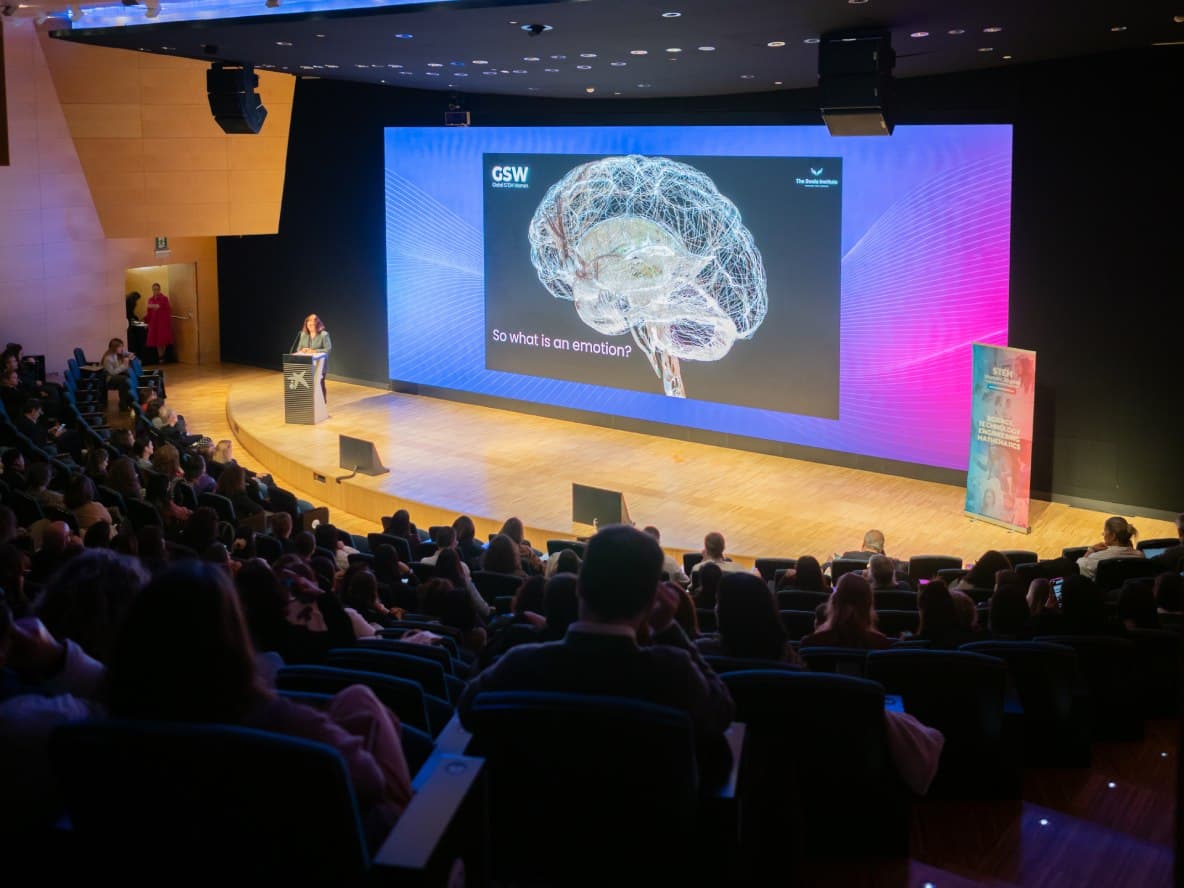
The Academic Director of UPF-BSM’s Executive MBA explores the application of neuroscience to decision-making, emotional management and leadership at STEM Women Congress Barcelona.
How does the way our brain works influence the way we make decisions and lead teams? This was one of the central questions addressed by Katharine D’Amico, Academic Director of the Executive MBA (EMBA) at UPF Barcelona School of Management (UPF-BSM), during her participation in STEM Women Congress, held at CosmoCaixa in Barcelona.
Specialising in applied and cognitive neuroscience, decision-making, stress and trust, D’Amico explained how brain processes and emotions shape human behaviour, particularly in professional environments. “Every act of leadership starts in the brain,” she stated during her presentation, in which she explored the relationship between neurological processes, behavioural dynamics and social relationships.
One of the key aspects she highlighted was the relationship between emotion and rationality in decision-making. “Emotions are not the enemy of decision-making,” she pointed out, adding that “it is not possible to separate a decision from emotion”. As she explained, emotions help the brain identify which aspects of a situation require attention and guide our responses. In this regard, she challenged the perception that emotions should be excluded from decision-making processes, particularly in professional settings.
Uncertainty management
Neuroscience also helps us understand how we react to situations involving uncertainty, stress and risk. D’Amico explained that, in high-pressure situations, certain brain responses can encourage caution and risk avoidance. “Understanding these mechanisms allows us to identify how our reactions are formed and which factors may influence them,” explained the UPF-BSM EMBA director.
In this regard, she argued that courage does not depend on feeling prepared or confident beforehand. “Courage comes before confidence,” she stated, adding: “We act with courage first, the brain learns, and confidence comes afterwards.” To develop this ability, she identified three key elements: learning to reframe stress, building relationships based on trust, and training ourselves to face situations of uncertainty. “Experience transforms neurons,” she recalled, referring to the brain’s ability to modify its connections through lived experiences. The professor concluded her presentation with a clear message to the audience: “Act with courage before you feel confident; embrace uncertainty and your brain will do the rest.”
The day before the congress at CosmoCaixa, UPF-BSM hosted the 1st High Level STEM Forum at its headquarters, the event preceding STEM Women Congress (Pre-Congress Event). The meeting brought together representatives from governments, universities, companies and organisations across the international STEM ecosystem to discuss the barriers and opportunities for advancing gender equality in science and technology. The event included a collective deliberation session aimed at developing a joint resolution outlining future priorities and commitments.