


Leading sports journalists analyze Lamine Yamal as a global role model at a new Leaders at UPF-BSM session
3 Noviembre - 2026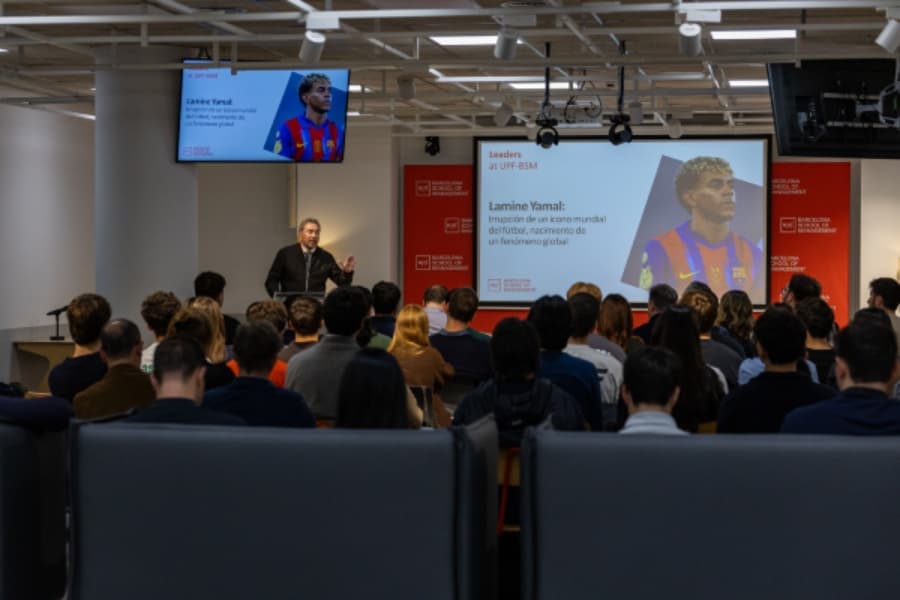
The UPF Barcelona School of Management (UPF-BSM) has hosted a new session of its Leaders at UPF-BSM series, this time focusing on the phenomenon of Lamine Yamal and his impact beyond football. The event explored how the FC Barcelona player has become an internationally recognized figure and a cultural, social and generational role model. The session featured sports journalists Anaïs Martí, Aitor Lagunas and Santiago Segurola, and was moderated by Sergi Cortiñas, director of UPF-BSM’s Master’s in Sports Journalism.
The three speakers offered different perspectives on football’s media profile and the way major sporting phenomena are shaped. The event also marked the inauguration of a new cohort of the Master’s in Sports Journalism, a programme that connects the analysis of sport with communication and the changes transforming the sector.
One of the starting points of the discussion was Lamine’s journey to the FC Barcelona first team. Anaïs Martí highlighted the combination of influences that shaped him as a footballer: “Lamine Yamal has combined street football with the talent he gained at La Masia.” Aitor Lagunas also pointed to the role of the digital environment in the generational dimension of the phenomenon: “There may be another [factor], which is the more generational factor, the factor of social media, the factor of how phenomena such as Lamine Yamal are communicated in the 21st century.” His profile extends beyond the pitch and, as Santiago Segurola noted, reflects the player’s ambition to become a role model for his generation: “He is more than a player and he knows it. He is an icon; he wants to be a generational icon.”
The social dimension of this figure is also closely linked to his roots. Anaïs Martí recalled that Lamine grew up in Rocafonda, the neighborhood in Mataró that has shaped his personal story and which she described as “multicultural, working-class and humble.” Martí explained the significance of his 304 celebration, referring to the last three digits of the neighborhood’s postcode, which for the footballer represents “a statement of belonging, of not forgetting his roots, of not forgetting where he comes from.” She also highlighted how Lamine sends a message to children in the neighbourhood: even if they grow up in a modest environment, they can still aspire to achieve their dreams.
Lamine’s example also prompted a discussion about how each generation understands leadership and authenticity. Santiago Segurola highlighted the player’s determination to preserve his personality and maintain a degree of independence in his decisions: “Lamine tries to maintain a very high degree of autonomy.” In this regard, he noted that, despite the commercial interests surrounding the player, he believes that “he is not a robot” and that “he maintains his personality.” Segurola also encouraged reflection on society’s perception of the player and how we interpret what he represents: “Lamine tells us how we behave towards him.”
The discussion highlighted that leadership is not built solely in fields such as business, politics or academia, but also emerges from sport and culture, through figures who can transcend their discipline and inspire new generations. In this regard, UPF-BSM director general José M. Martínez-Sierra stated during his address that “understanding sport also means understanding business, institutions and leadership.”