


Spain ranks among the worst in Europe for affordable housing: the UPF-BSM and Metropolitan House Foundation Chair takes stock of five years of research
12 Noviembre - 2026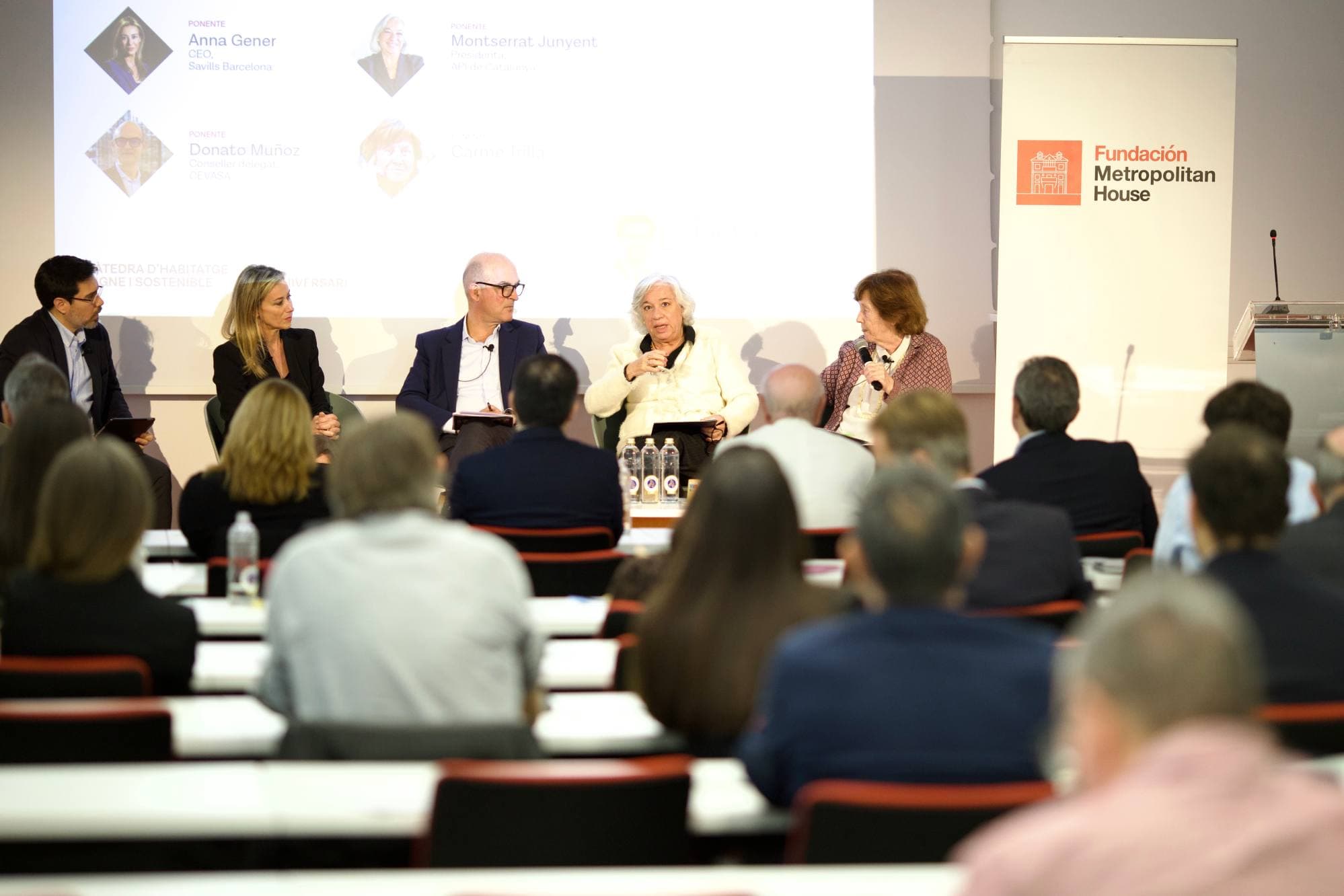
The Chair in Decent and Sustainable Housing of the UPF Barcelona School of Management (UPF-BSM), established with the support of the Metropolitan House Foundation, has marked its fifth anniversary with an event taking stock of progress and reflecting on the challenges of access to housing in Catalonia and Spain. The event brought together institutional representatives and professionals from the real estate and social sectors to highlight five years of research and examine the main challenges involved in expanding the supply of affordable housing.
The celebration comes the day after the general housing strike and just ahead of the start of the 29 November election campaign, amid growing public and political debate about access to housing. In this context, the Chair’s studies highlight the structural shortage of affordable housing in Spain, where this type of housing accounts for between 1% and 2.5% of all households, compared with 15–25% in benchmark European countries, according to research published in December 2025.
In this context, Ramon Bastida, Director of the Chair, said that the measures adopted by public authorities to expand the supply of subsidised and affordable housing would still take time to translate into new homes becoming available. According to Bastida, while measures to increase supply will mainly have an impact in the medium term, rent-containment policies implemented in stressed housing market areas may already be starting to show results in the shorter term, although, in his assessment, these remain very limited.
Five years of research into affordable housing
Josep Lluís Pellicer, Secretary of the Metropolitan House Foundation, and Bastida reviewed the main contributions made by five years of research into the social, economic and environmental challenges of housing.
“Over five years of research, we have established that the affordable housing problem is, above all, a problem of supply. To move closer to European levels, public authorities, the private sector and the third sector need to work together,” said the Chair’s Director.
To help expand the housing stock, the Chair’s research has examined various approaches, including public-private partnerships through mechanisms for the transfer of public land and the mobilisation of investment; new models for providing social housing inspired by European housing associations; and industrialised construction, which has the potential to reduce construction times, costs and environmental impact.
For his part, Josep Lluís Pellicer highlighted the history of collaboration between UPF-BSM and the Metropolitan House Foundation and its contribution to generating knowledge about housing. “The collaboration between the university and the Foundation has enabled us to generate knowledge that is useful to the sector and to public authorities, at a time when housing is a social and economic priority,” he said.
Looking ahead to the coming years, the Chair is already working on two new research projects. The first examines innovative financing instruments to mobilise the capital needed to promote new affordable and subsidised housing projects. The second focuses on the use of timber in residential construction, analysing the entire value chain, from forest management to its application in building.
The market, rental housing and the third sector around the same table
The event included a round-table discussion moderated by journalist and UPF-BSM professor Toni Aira, bringing together different perspectives on housing challenges: real estate consultancy, represented by Anna Gener, CEO of Savills Barcelona; real estate agents, represented by Montserrat Junyent, President of the API Association of Catalonia; the rental housing sector, represented by Donato Muñoz, CEO of CEVASA; and the third sector, represented by Carme Trilla, President of the Hàbitat3 Foundation.
The experts assessed the current housing situation in Spain, focusing in particular on the shortage of affordable housing. The discussion examined how the construction of this type of housing can be encouraged, the actions being taken by public authorities and the obstacles currently holding back the sector’s development. The experts also reviewed measures to regulate the rental market and discussed its future prospects.
Housing: a competitiveness challenge for SMEs
The event also addressed the economic consequences of difficulties in accessing housing. Oriol Amat, Professor at UPF-BSM, presented data from the Catalan SME Observatory showing how housing and mobility problems affect recruitment, labour costs and business growth decisions. According to these data, 68.6% of the companies surveyed identified at least one housing- or commuting-related factor among the difficulties they face in filling vacancies, while 28.3% had decided not to increase their workforce because of these issues.
Amat argued that housing, mobility and economic development policies need to be addressed together, through measures such as promoting affordable housing close to business hubs, improving connections to industrial estates and incorporating these needs into support schemes for SMEs.
The event opened with institutional welcome addresses by José M. Martínez-Sierra, Director General of UPF-BSM; Rafael Angulo, President of the Metropolitan House Foundation; and Jordi Mas, Director General for Housing of the Government of Catalonia.
“Universities must play an active role in addressing social challenges such as access to housing by providing rigorous research and knowledge. These five years of the Chair demonstrate the value of collaboration between academia and the private sector in driving solutions with a real impact on society,” said the Director General of UPF-BSM. Rafael Angulo, in turn, emphasised: “Housing is a fundamental pillar of the welfare state and a right recognised in our Constitution. At the Metropolitan House Foundation, we want to help make this right a reality by promoting, together with UPF-BSM, the research and knowledge needed to move towards a more decent and affordable housing model.”
The Best Master’s Thesis Award was also presented by José Vicente Muñoz, Director General of the Metropolitan House Foundation, to Luis Javier Ramos Medina. The event was brought to a close by Joan Ramon Riera, Housing Commissioner of Barcelona City Council.