



- About UPF-BSM
- Programs
- Faculty and research
- Companies and Organizations
- News & Events


UPF-BSM faculty come together to reflect on conscious management
8 Julio - 2026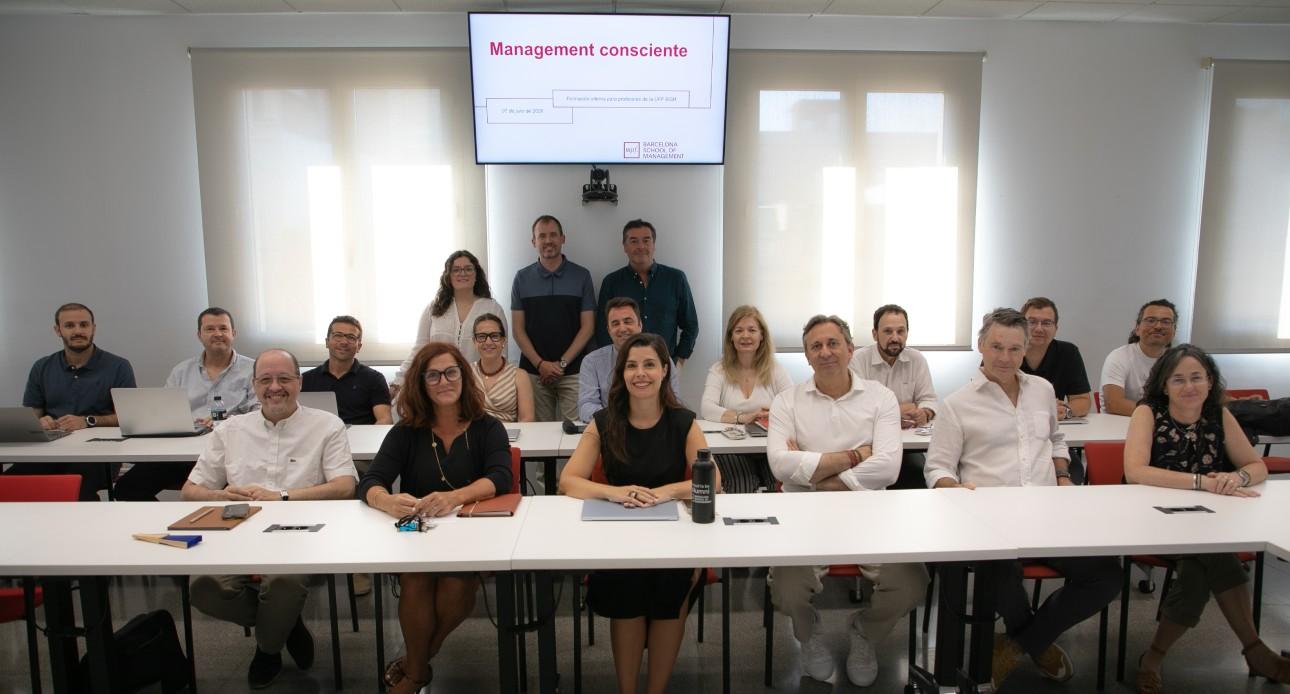
The session explored the theoretical foundations of this management approach, discussed how it can be integrated into teaching, and examined the practical case of Uriach.
Around twenty faculty members from a wide range of academic disciplines at UPF Barcelona School of Management gathered on 7 July for an internal training session on conscious management, a management philosophy that argues that the economic success of organisations is fully compatible with human development and the creation of value for society as a whole. Rather than viewing these objectives as conflicting, this approach maintains that they reinforce one another and provide the foundation for organisations that are more excellent, sustainable and competitive.
The session opened with a keynote by Professor Oriol Montanyà, who presented three of the core pillars of conscious management. First, he argued that an organisation's success depends far more on how things are done than on what is done, highlighting the importance of quality work and shared values. Second, he explained that this "how" requires a genuine purpose to guide decision-making and strengthen people's commitment. Finally, he emphasised that the key strategic contribution of conscious management lies in recognising that organisations must create balanced value for their five main stakeholder groups: customers, employees, suppliers, society and investors.
Educating Conscious Leaders
The session continued with a presentation by Konstantin Mudrack, co-founder of Conscious Capitalism Spain, who explained how these principles can also be applied in higher education. Drawing on the Conscious Business Education Framework, he argued that educating future conscious leaders depends not only on the content delivered in the classroom but also on teaching methodologies and faculty development. He also presented several initiatives already implemented by international business schools, including Erasmus+ programmes that incorporate these principles.
The second part of the session consisted of a group workshop in which participants reflected on the extent to which these principles are already embedded in the various courses taught at UPF-BSM. The discussion revealed that levels of integration vary across academic disciplines, but also that, often unconsciously, some traditional management assumptions continue to be transmitted in the classroom. Participants also shared teaching best practices, including the use of the Balanced Scorecard to broaden performance measurement beyond financial indicators and incorporate value creation for different stakeholder groups. The debate also highlighted that these new approaches can help increase student engagement and participation at a time when in-person classroom attendance is declining across higher education.
The Uriach Case
The practical case study was presented by Oriol Segarra, CEO of Uriach, who shared the company's transformation over the past fourteen years. Segarra described a humanistic leadership model that has helped turn Uriach into a company with annual revenues approaching €500 million, demonstrating that conscious management not only has a positive impact on people and society but also drives competitiveness and profitability.
He argued that companies should aspire to become great places to grow—environments that foster safety, trust and personal development. "When people work driven by commitment and passion, rather than simply by a contract, a kind of human magic is unleashed that makes extraordinary results possible," he said.
Segarra also argued that, after more than two centuries of prosperity driven by the combination of democracy and capitalism, the time has come to evolve this model, with businesses—rather than governments—taking the lead in driving this transformation.
The session concluded with remarks by Professor Marcos Eguiguren, who reaffirmed UPF-BSM's commitment to this new management paradigm. Eguiguren highlighted that the School is a founding member of the Global Alliance for Conscious Business Education, an international network of business schools committed to advancing this model, and stressed that this commitment is embedded in both the institution's strategic plan and its DNA.
"We promote this responsible way of managing organisations because we believe it is the right thing to do, because it is a source of excellence, and because it is our contribution to the society of the future," he concluded.